Showing posts with label Da Vinci Code. Show all posts

Sunday, December 3, 2006

Don't Hate, Educate!

The roadshow continues... CDPC will be having two-part sessions on discussing these issues this coming and the next weekends.

Worship Service 1: Saturday 6:00 pm
Worship Service 2: Sunday 10:00 am

I know, some of you all start to 'jelak' of the overexposure of Da Vinci Code, rite? But this is just the start of things to come :)

Dr Alex Tang wrote the following perceptive comments on DVC

My personal approach is to engage falsehood with the truth. Again I do not agree with Ms.Nicolosi that a dialogue with the issues raised by the movie
is ‘debating the devil’. Truth needs to be told. St. Paul mentioned that if we do not tell the truth, who will then? Again truth is like a beam of light. Light drives out darkness and deception.


One reason we, Christians, fear the book and the movie is that we ourselves do have not sufficient knowledge about out own faith and church history. That’s why we are so easily swayed by false doctrines that blow our way. I think this is a good opportunity for us to reexamine our faith and our own beliefs. Time for us to review our knowledge about

(1) How did the formation of the canon of the Bible come about?
(2) Was our Bible edited to suit a particular politics or viewpoint?
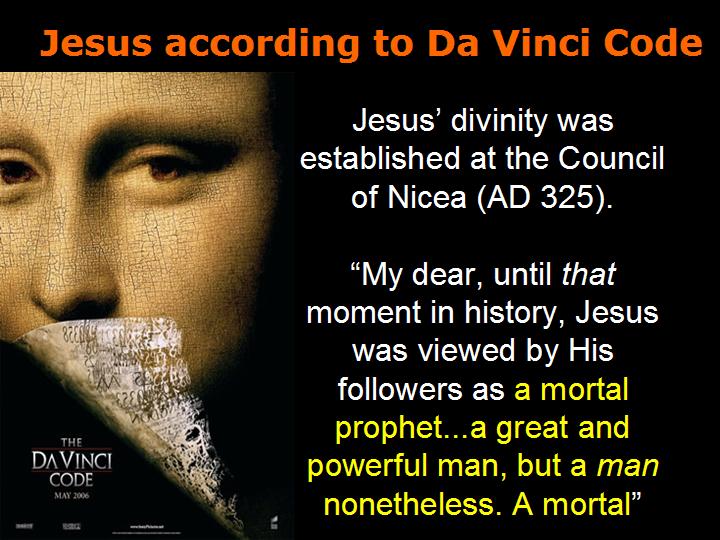
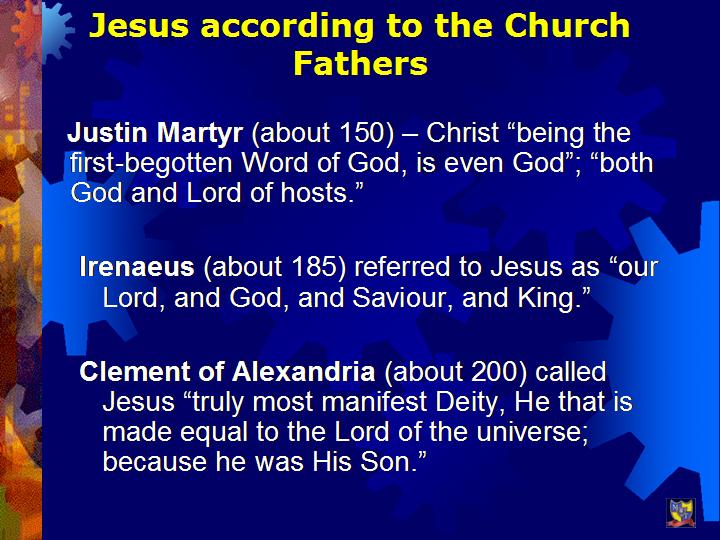
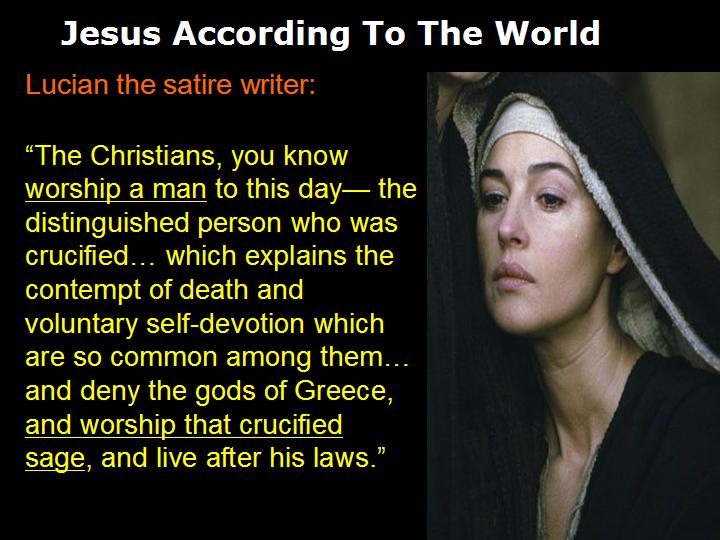
(3) Is Jesus just a mortal man and Emperor Constantine made him God?
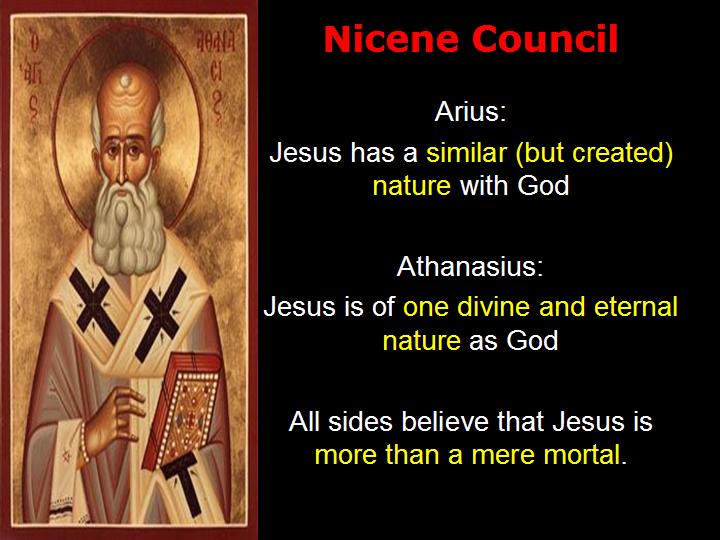
(4) What happened at the Council of Nicea?
(5) Who was Mary Magdalene?
(6) When did Mary Magdelene become our model for a reformed prostitute?
(7) What was the relationship between Mary Magdalene and Jesus?
(8) Who is the Priory of Sion? The Knight Templar? The Opus Dei?
(9) What is Gnosticism?
(10) What are the ‘lost’ gospels?
(11) What information did the Dead Sea Scrolls give us?
(12) What information did the Nag Hammadi Documents give us?
(13) What is ‘goddess’ worship?
(14) Does reading The Da Vinci Code shake our faith?

If we are unable to answer these questions above, then it is time for us to do something about it.


While some quarters prefer to boycott, ignore, ridicule or dismiss DVC as if it's silly or harmless 'fiction', let's face it... only christians have the luxury of pretending it never happened or that it's completely baseless.

The people 'out there' still want to know some answers no matter how nice Christians can appear to be, lor. What are the facts? What's the fiction?

Jedibaba weighs in:

I am not a Christian because it is a convenient faith to follow. I have enough problems putting my mind around concepts like the Trinity and the Incarnation for myself much less explain them to those outside the church. And I am definitely not in the market for martyrdom.

The only reason why I am a Christian is because I believe Christianity to be true. And I believe Christianity to be true because it speaks to the deepest needs of my heart, yes, but also because it is based on things that really happened.

I was born in a Christian family so my faith was not really tested till I came to a point in my life when I believed that the Lord was calling me to give up a career in
dentistry to go into the bible teaching ministry. For the first time in my life following Christ was going to cost me something. For the first time I had to be sure. And it was the overwhelming evidence for the resurrection that kept me
convinced.

Here I am in good company. The resurrection was also the clincher for the apostle Paul.

"And if Christ has not been raised, your faith is futile; you are still in your sins. Then those also who have fallen asleep in Christ are lost. If only for this life we have hope in Christ, we are to be pitied more than all others. But Christ has indeed been raised from the dead, the firstfruits of those who have fallen asleep." [1Corinthians 15:17-20]


It seems obvious now that every Christian must be thoroughly grounded in the historical bases of the Christian faith. These include the reasons why we believe in the resurrection, and its significance. Christians should also be schooled in things like the canon of Scripture and key events in church history like the Council of Nicaea.

We can no longer avoid teaching such topics on the grounds that they are boring. This does not mean that we should not work at making the teaching of such topics interesting and relevant. But it needs to happen.

The Da Vinci Code phenomenon is just the latest "hack" on the truth system of Christianity. We should be grateful for this wake up call and get our act together.
a

Is Engagement Compromise?

Just survived a 4 session forum on Da Vinci Code in CDPC. The community of faith was appreciative, and happy to see a hunger to discover more about Christ and the Bible deeper.

Thank you for the support and encouraging words. The Power Point slides will be made available upon request at hedonese at yahoo dot com

Has been a hectic month... More invites came in from International Medical College student group and Methodist Boy's School while the topic is hot, I hope to finish them before going off to Minneapolis in July. (Bethlehem Baptist, here I come!)

The Westminster Confession mentioned a church leader's duty to refute prevailing errors BUT warned them not to raise dead heresies from the grave :)

Which category does Da Vinci Code fall into? I find Bock's blog helpful here (quoted in full)

Two questions I often get are: (1) does not engaging bring more attention to the novel, feed its marketing apparatus, making more money for someone who slandered Christianity? and (2) does not engagement constitute compromise, a kind of dancing with the devil? Where does one draw the line on engagement?

These are fair questions. I think the responses also make sense. It is certainly the case that engaging the Code and other controversies like it fan the flames of attention and bring the novel more visibility and probably more money. But there are other factors in this particular case that made engagement necessary. In contrast to the Last Temptation fo Christ, which one coudl ignore becasue it never had "legs," this novel did hit a cultural nerve as indicated by its sales in the millions and the questions it caused readers to ask about the early history of Christianity. The novel was already a cultural phenomena by the time I was asked to write about the movie (I did not seek to write Breaking but was asked to, so I did not take on the project for money but out of a belief in the need to respond with substance). By then, the novel had already sold close to 10 million copies in its first few months.

This meant that the novel's ideas were already circulating, drawing both much
attention and public discussion. This also meant the novel had to be engaged. To be silent was to let these ideas simply have the floor by default. To protest was simply to accomplish the same thing.


The church needs to find a different way to dialogue with the culture than simply being angry or whining. If Christianity's case is stronger than Dan Brown's views about it, then we do everyone a service by letting them know that. Failure to respond with substance gives outsiders the impression we do not have a case or have somethign to hide. We cannot make progress by simply affirming our view without backing. Everwhere where engagers have spoken they have made clear their objections to the book. In a world where ideas matter, contending for them in the public sqaure is what the church must do.

More than that, getting this information out was important to the educating of the church as well as the culture. This education became necessary because the church had not done a great job of educating its members about its early history, leaving them exposed to the negative influence of a work like this. Dan Brown exploited a black hole in people's knowledge, a black hole the church had allowed to exist because we tend to only discuss experience or felt needs. Engagement not only
makes a positive case to those who are curious about the truth of religious claims, it also protects the church from ideas that can function like a destructive virus if it catches hold.

But what about the second question? Is this kind of engagement not dancing with the devil? Was not the decision to write for a site Sony underwrote the wrong move? I think not. My goal as I stated in the May 14 blog was the reader. This meant going where the questioning reader was. Although there were many Christian sites for whom I and others also wrote, it was less likely that the skeptical reader would visit such a site. So it was judged an important consideration to go where the skeptical reader might be. There was no money accepted from Sony to write these articles. This kind of commitment to engagement is why Jesus ate meals with who he did, entered syangogues and temple squares to teach. This kind of commitment to engagement also explains why Paul went to places like Mars Hill.

But where does one draw the line? Why is not the next argument that we should go to immoral places to be with the unbeliever? The answer to that question is simple. What this kind of exchange does is engage with ideas, not acts, in the public square. The church has always been about sharing its ideas with those in the public square, including engaging other theological, religious, and philosphical ideas.


Another objection often follows. Does not that exchange risk giving attention to the ideas being challenged? Yes, that is a risk, but only if the case of the engagers is weak. That has not been the case with the novel. I think we can argue that certain ideas were softened between the novel and the movie, as some claims of the novel did not have as key a role in the movie (No mention of 80 gospels and only a quick reference to Nicea). Other ideas were debated in the movie when they were simply presented as true in the novel. Not only that but the media's fact checkers of the
"debunkers" generally agreed that they had exposed the errors in Brown's self-proclaimed careful research. With doubters of his claims coming from all stripes of theologians, historians and art historians, engagement had the desired impact of leaving people to emphasize that the book in only fiction after all. This was a good outcome for those considering the claims of the book, since one should not learn history through fiction.

So there is a risk in engagement. It does raise the visibility of a controverisal topic. However, when that visibility already exists, it is imperative to engage, lest the impression be left that the controversial view, not made so very public, is also true. Engagement is not compromise; it reflects a genuine concern that people not be misled.

The Son Is Risen I

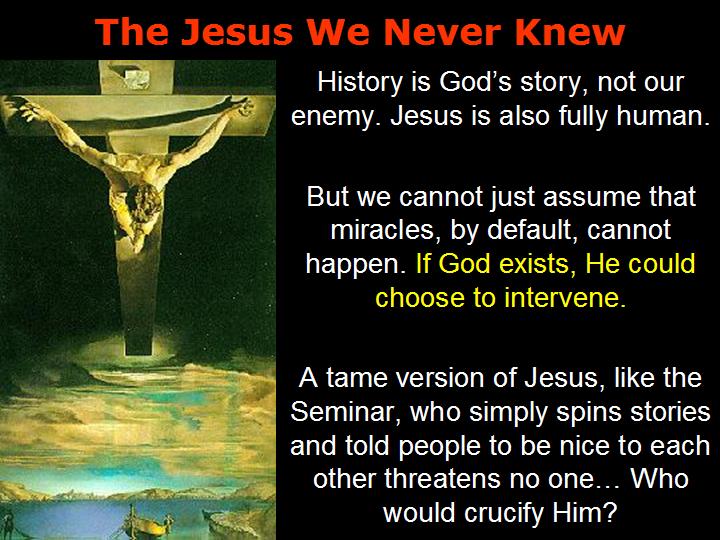
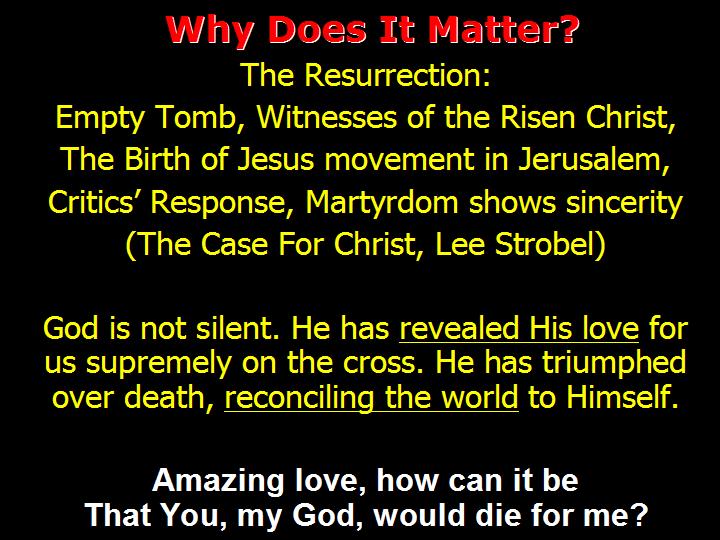
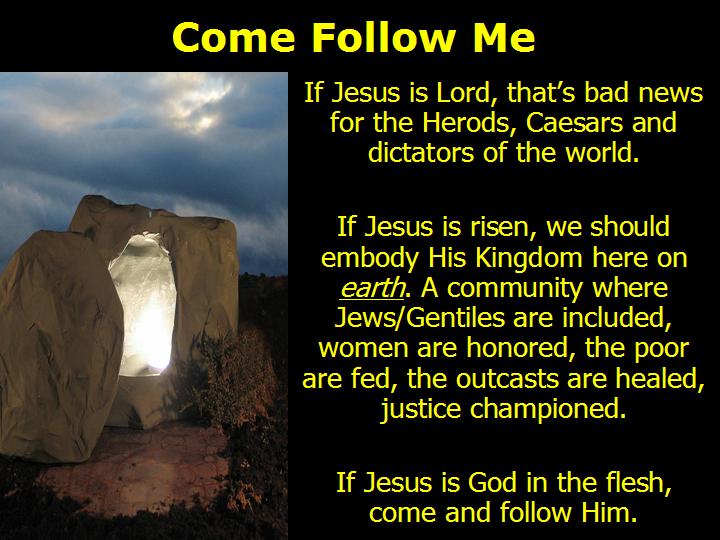
The Da Vinci Code phenomenon is a teaching moment when we could once again be grounded in a renewed interest in Church History and Divinity of Christ was given in CDPC on 27 & 28th May. Credit for the materials goes to Dave Geisler's excellent training resources.


The Son Is Risen II

The following presentation on Church History and Divinity of Christ was given in CDPC Da vinci Code forum on 27 & 28th May.


Saturday, December 2, 2006

Why Is Da Vinci Code Popular?

Scott McKnight posted these questions on Da Vinci Code:

What I want to know is this: Why did so many people want to believe this story? Why did so many wonder if maybe the Church has duped the entire Church for 2000 years? Why did so many wonder if maybe the Church buried other versions of Jesus? Why did so many wonder if the Church suppressed the truth all along? Why did so many want to believe that the Church was an ideological power that was threatened by alternative stories?

This is really only one question — why did so many seem to think this version of the Christian faith was believable? — and it is for me the central and only genuinely abiding question that this book provokes.


In fact, some of these questions came up in both Da Vinci Code forums which we organised earlier. In the SIB Living Room, Ian made the point to ask us what are the 'good stuffs' that we can learn from DVC to 'broaden' the discussion a bit.. So we're seeing another example of 'convergence' here, which is cause for celebration. But I also note that these questions are usually asked by Christians who already know that the 'facts' are really fiction...

And they wanna know "Why on earth wud intelligent folks buy into these conspiracy theories?" The fence-sitters wud still ask abt "Is it true? Really true?" Chris asked the good question, "What makes Da Vinci Code so amazingly attractive to so many people?" and got mistaken for a Malaysian Gnostic heheheh...

Here are some 2 yens... Even as we speak, there are strong undercurrents and energy behind these movements in the US of A.

Neo-Gnosticism

Neo-gnosticism of Harvard scholars (elaine pagels/karen king) which try to sell us the idea tat early church has so much 'multiplicity of views' that orthodoxy is meaningless to them. So gnosticism is a valid option before it's suppressed by party-spoilers like Constantine. It's VERY attractive bcos of its boundary-lessness, we can remake Christianity the way we now see fit.

Jesus Seminar

Of course, there are Jesus Seminar folks who emphasize a merely 'earthly Jesus' bcos of the 'assured results' of modern historiography vs 'religious dogma'. Again, it's attractive bcos when scientific history is set against dogmatic doctrine, guess who wins?

Feminism

This is the part where there is more than a strand of truth. Yes, the church has not always been faithful to biblical teachings to affirm the worth and role of women in the church. More than one reader have told me that they felt DVC 'honors women'.

Yet Dan Brown's divinization of the feminine (which is as idolatrous as the divinization of the masculine) is wrong-headed solution. If you wanna find an alternative christianity that affirms women, you'd never find it in Gnosticism which has a low view of women, sex and the physical world.

Suspicion of Authority

It feeds on the modernistic mood that feeds on Suspicion of Authority and disillusionment w 'hypocrisy' and 'exclusivity' with the religious establishment. (smells like Enlightenment!)

Choose what you like spirituality..

If u can't find, make it up as you go.
Very New-Agey.

I was reading the gospel of thomas and found tat u cud substitute Jesus for Buddha, and you'd get basically the same thing as Buddhism. "Look inside yourself, what you bring out will save you". Pagels mentioned a theory that this strand of gnosticism may have influence from India. (Thomas was reputed to be an apostle to India rite?)

A Sexier Religion
There is more than a hint of a revived, neo-pagan 'spirituality' that revels in sexual orgy. And don't we all know that sex sells?