Showing posts with label Theology. Show all posts

Sunday, December 13, 2009

Book Review: Man's Search For Meaning by Viktor Frankl


Questions about life’s meaning and suffering which were formerly handled by priests or rabbis are now increasingly confronted by psychiatrists and doctors. In his bestseller Man's Search for Meaning, Dr Victor Frankl highlighted the distinctive of logotherapy, also known as the “Third Viennese School of Psychotherapy”, as the idea that “the striving to find a meaning in one's life is the primary motivational force in man”. Therefore, for logotheraphy, the focus is on the will to meaning in contrast to the will to pleasure of Freudian psychoanalysis and the will to power stressed by Adlerian psychology. While Freud and Adler tried to discover primal drives latent in the past, Frankl focuses rather on the meanings one is called to fulfill in the future. In his moving autobiographical account of experiences in a Nazi concentration camp, he observed how prisoners who lost hope in the future would be subject to mental and physical decay.

According to Frankl, man’s search for meaning is not a derived projection from more basic instinctual drives or sublimations. Otherwise it would lose its ability to challenge or summon him to live or even die for these values. Unlike Sartre’s axiom that existence precedes essence, Frankl’s existentialism asserts that the meaning of our existence is not invented by ourselves but rather we discover it as ‘something confronting existence’. Those who lack a meaning worth living for and find an inner void within their hearts experience ‘existential vacuum’. This is a widespread phenomenon of the twentieth century due to the loss of traditional values and rampant industrialization, manifesting itself in boredom, addiction, the will to money, apathy or unbridled sexual libido.

As a Christian, I applaud Frankl’s critique of the determinism prevailing in much of psychoanalysis that reduced man to nothing but a victim of hereditary or environmental conditions. We share the hope that a ‘rehumanized psychiatry’ would replace the tendency to treat human minds as machines and focus on mere techniques. Indeed, Frankl’s view of man is biblical in the sense that man has both the potentials of behaving like a swine or a saint. Man’s dignity lies in him being created in the image of God and yet marred by the depravity of sin. However, Frankl has an overly optimistic view of human freedom in which even the most evil persons are ultimately self-determining. Through restricted by conditions, they are free to change their own destiny. In the Christian perspective, fallen man is in need of divine rescue and inner liberation before such a change is possible. As long as his basic orientation is self-centered, the outward change merely vacillates between hedonism and legalism. ‘Existential vacuum’ (and its symptoms) express in modern terms Augustine’s ancient prayer that our hearts are restless until they find fulfillment or satisfaction in God.

Read on for the rest of the article

Monday, September 8, 2008

Merdeka Sermon

Independence Day sermon on 31 August 2008. Audio download will be available here soon.

Selamat Hari Merdeka! Today we celebrate 51 years of independence. Are you feeling patriotic today? There are many things we could be thankful for and achievements that are worth celebrating.

For example, in just about 50 years, we have transformed from an agricultural economy to an industrialized nation with a fast-growing urban middle class. You can see signs of modern progress everywhere with high-tech buildings like Twin Towers, KL Tower, KLIA and so on. By and large, we have also lived in peace together in a culturally diverse society. We live amongst Malays, Chinese, Indians, Kadazans, Ibans, Sikhs dan lain-lain. And except for that infamous 1969 riot, we have been spared from the communal violence that happened in other nearby places like Indonesia or Southern Thailand.

Having said that, there are also many weaknesses that we need to overcome if we really want to be a developed country by 2020. Before we get to that, let us turn to the passage of Scripture for today

Psalm 93
1 The LORD reigns, he is robed in majesty;
the LORD is robed in majesty
and is armed with strength.
The world is firmly established;
it cannot be moved.
2 Your throne was established long ago;
you are from all eternity.
3 The seas have lifted up, O LORD,
the seas have lifted up their voice;
the seas have lifted up their pounding waves.
4 Mightier than the thunder of the great waters,
mightier than the breakers of the sea—
the LORD on high is mighty.
5 Your statutes stand firm;
holiness adorns your house
for endless days, O LORD.

We Malaysians are living in very, very interesting times. Our newspaper headlines these days are so full of suspense and intrigue that they make even Obama look so boring in comparison. Almost every week, we have shocking revelations of sex, lies and videotapes… statutory declarations flying here and there with allegations of political conspiracies, cover-ups, spies, murder, sodomy and C4 explosives! I think someone should make a movie out of all these drama and sure can make a lot of money. Who knows? Maybe can even win an Oscar!

But seriously, I think our nation is at a crucial crossroads of sorts… winds of change are blowing and powerful opposing forces are shaping where Malaysia will be for the next 50 years. So the theme for church camp this year “For Such A Time As This” and the message of Esther is especially timely and relevant.

The last general election on March 8th (so called political tsunami) raised some interesting questions: Could we be seeing the beginning of a two-party democracy in Malaysia? Like in US, they have Republicans and Democrats. The morning after, we woke up to find ourselves living in a state ruled by Pakatan Rakyat.

Are we beginning to see that finally Malaysians have matured enough to go beyond racial politics? In the past, Chinese only vote for ‘Chinese’ parties like DAP or MCA, Malays only vote for PAS or UMNO, Indians only vote for MIC or MIC… But now we have Makkal Sakti?! This time around, we see a mood for change among Malay, Chinese and Indian communities.

But there are also fears that in this desperate moment of transition that communal violence may flare up once again. We have different ethnic and religious communities living side by side with each other but with precious little contact and understanding in between. On the night of March 8, many of us get SMS to stay at home and be careful for fear of violence.

While all these things are happening, petrol and food prices are going up. A globalizing economy is getting more competitive.

The Malays have this saying “Gajah sama gajah berjuang, pelanduk mati di tengah”. As Malaysian Christians, we watch much of the drama and sandiwara like the kancil (mousedeer) caught between two fighting elephants. We have no political power. Just a small minority. I wonder what are your feelings at this time of uncertainty?

Some of us may feel
Fed-up or ‘Jelak’: “Look at how dirty and corrupt politic is. Christians should never get involved in it.”
Cynical: “Aiya… What difference can small fries like us make la? We have been like this for 50 years, we will remain like that for another hundred years. Migrate better.”
Hopeful: “I think things are changing for the better. If So and So becomes Prime Minister, then our country’s problems will be solved.”
Confused: “Where is God in all this? What does God want the church to do?”

The passage of Scripture today from Psalm 93 points us to the throne of our sovereign God. “The LORD reigns, he is robed in majesty; and is armed with strength.”

Although we are weak and needy people, God is mighty and strong. Where is God in the midst of all these events? He is on His throne. His throne was established from eternity and will last forever. He created the entire universe, the galaxies, solar systems and everything in it out of nothing. And He sustains the whole creation and set up physical laws that keep them from falling apart.

Isaiah 40 describes God’s power in poetic terms: He measured the seas in the hollow of his hand and mark off the sky with his hand, he weighs the mountains on scales and the nations are like a drop of water in a bucket… That’s how awesome and great is our God.

Psalm 93 is an enthronement psalm that worshipfully celebrates the fact that God is the ultimate ruler in the nation of Israel. In the other surrounding nations, the king is also considered divine and their power is absolute. But for Israel, though they have a human king, but the king is ultimately answerable to the divine King and the ‘constitution’ of the nation, that is, the covenant the Lord made with Israel. No one is above the rule of law, not even the king (Deuteronomy 17:18-20)

Our human rulers like Yang Dipertuan Agong and Prime Minister and Cabinet members, state governments are ultimately God’s servants/ministers to bring justice and order in society (whether they know it or not). So our default position is to obey their authority and laws of the land and pray for them. But their authority is not absolute, there is a higher law/King that even our rulers must answer to. If the state acts and speaks as if it is god, demanding our ultimate loyalty and obedience, then it has become an idol and we have the freedom and responsibility to disobey unjust laws.

If our vision of God is too small, we’d be too impressed or depressed by men or what’s happening in this world. But if we see how awesome God really is… how majestic His rule is over our national affairs… We can still be aware of what’s happening in the world but we’d be more impressed with God. And whoever becomes Prime Minister on Sept 16 or 4 years from now… no matter how things turn out… we are reminded that God is still on the throne and His rule is everlasting. No one can frustrate his plan and purpose.

Like we saw in the story of Esther, the invisible hand of God (His providence) is quietly working behind the scenes, putting the right people at the right place to do the right things at the right time. Even the sinful actions of men, God can use it and turn it around for his own purpose. Like Haman who set up a trap for Mordecai and the Jews but it ended up as a trap that ironically backfired.

Psalm 93 also gives us a picture of chaotic, tsunami-like waves that represent all the threats and upheavals against the rule of God. But the Lord on high is mightier than all of them.
3 The seas have lifted up, O LORD,
the seas have lifted up their voice;
the seas have lifted up their pounding waves.
4 Mightier than the thunder of the great waters,
mightier than the breakers of the sea—
the LORD on high is mighty.
So our trust and confidence are anchored on solid Rock. We can take comfort that God is big enough to protect and carry us through.

Remember this scene from the movie: “The Lord of the Rings”?

Frodo, the small innocent hobbit who was given the dangerous task of carrying a powerful ring to the Enemy’s stronghold, said: I wish the Ring had never come to me. I wish none of this had happened.

Gandalf: So do all who live to see such times, but that is not for them to decide. All we have to decide is what to do with the time that is given to us. There are other forces at work in this world, Frodo, besides the will of evil.

We may wish for the good old days when things are more stable… economy is growing… yet sometimes, it’s not up to us to choose or decide. But we can choose what to do with the kairos moment that is given to us, discern what God wants us to do in this small window of opportunity available today.

The sovereignty of God is not an excuse for laziness though: “Since God in control, I dun need to bother doing anything la”. No, the truth that God is sovereign sets us free from cynicism. Let me explain… For a long time, many young people are disillusioned and feel disempowered: “We are only small fries, what can we do? We can’t change anything” So they felt helpless and “tidak apathy”. They will complain and rant at the government at the mamak but they are not interested to be part of the solution.

But if our God is awesome and sovereign, and he s ultimately in control of our affairs, then no matter how difficult the problem in our country is, it’s not a problem for Him… and that should be a powerful motivation for us to action: To do justice, love mercy and walk humbly with Him. While we do these things, we await the day when Jesus will usher in his kingdom of peace and healing righteousness. So while life won’t be perfect on this side of heaven, we can work to improve it so that our church and society starts to look something like the future Kingdom of God today. It can be like a movie preview or foretaste of things to come.

In light of God’s sovereignty, how then shall we live? What can we do in this time of change and contribute to nation building? (3 applications)

1) This may sound very basic but the obvious things are usually the most important. If God is all powerful and rules over all and we are weak and powerless, the most obvious thing we can do is to humble ourselves and pray.

“And my people who are called by My name humble themselves and pray and seek my face and turn from their wicked ways then I will hear from heaven, will forgive their sin and heal their land” (2 Chro 7:14)
We need to pray for God’s Kingdom, God’s rule to come and His will be done here on earth as it is in heaven. If we do a stock take on our prayer life. What do we pray for most of the time? If our prayers are only limited to our own personal needs, it may show that we are too inward looking. We need to expand our horizon.

For example, NECF 40 days fast and prayer theme this year: “The Lord Revives: Transforming the nation through the local church”. Christians are called to pray our personal revival, then move outward to pray for the church, then the community (empower the community to work toward social justice and good governance) and government (a reformed police force that is corrupt free, impartial, competent and effective in upholding public order and peace). That’s the kind of world embracing prayer we need.

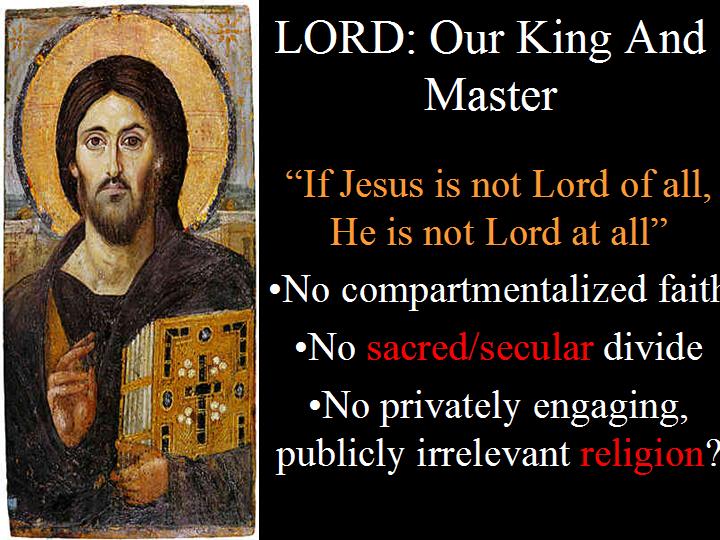
2) Abraham Kuyper: There is no sphere of life that is not subject to the sovereignty of Jesus Christ.

If Jesus is the King and Lord over all of our life, then we cannot divide our lives into neat little boxes like ‘sacred’ and ‘secular’. I don’t mean that we should form a political party called “Christian action Force” (Chrisaf) and try to make this country a Christian state. The church is called to bear the cross, not to pick up the sword. While Christian individuals could actively participate in political party, the church as the body of Christ should maintain a prophetic distance from partisanship and not be used as a tool by politicians.

What I mean is we cannot isolate the gospel from making an influence in the wider society.
We cannot say “OK religion is for Sundays and quiet time, but when it comes to my business decisions from Monday to Saturday, that’s secular stuffs so I play by different rules”…

If I’m a Christian lawyer, I can’t say: “Ok Christianity is what I believe when in church, but when it comes to the 1988 judicial crisis (In Malaysia we have the best justice that money can buy), I dun really bother”.

We can’t because God is not just interested in so called religious activities but how we conduct our lives in the marketplace. He is Lord of Sunday and the other six days also.

For example, He is interested in integrity and transparency in business practice and justice in the government:

Proverbs 11:1 “The Lord hates dishonest scales but accurate weights are his delight”.
Proverbs 29:4 “By justice a king gives a country stability, but one who is greedy for bribes tears it down.”

God has given us each one with unique abilities, skills, talents and resources. As we study in college/university or work, we begin to discover what our passion and super-powers are. These are things I like to do… These are things I am good at doing…

Spiderman said: With great power comes great responsibility. Our responsibility to redeem that sphere of life for Christ… It’s not easy, every industry has its unique challenges and opportunities.

If you are a salesperson, you are an “ordained salesperson”. You have been summoned by God to serve Him in that specific sphere of activity.
Or, if you are an “ordained lawyer”, you are called to prayerfully explore how your discipline shows signs of rebellion against or submission to Christ’s Lordship.
An “ordained environmentalist” ought to read the Scripture not just devotionally, but actively apply the biblical mandate for creation care in his work.

Whatever our calling is, we need to learn to think and live “Christianly” in areas specific to what we do – media, education, politics, business or the arts.

In humility and boldness, we should creatively integrate our faith with our vocation.

Laypeople in every facet of life – media, politics, business, education and others – should be enabled to challenge the prevailing assumptions of society in light of the gospel. Theology should not be reserved for pastors and scholars only! (Newbigin)

The biggest impact you can make for the kingdom is by being faithful to your calling and gifts that God has given you in the marketplace.


3) If God is the God of this city, Lord of this nation, King of all people groups as we have sung today, then we should work towards racial reconciliation.

The issue of race is sensitive and potentially explosive topic in Malaysia. Raja Muda of Perak, Raja Dr Nazrin Shah said this at a Student Leaders Summit 2007:

“To ensure sustained success at nation-building, Malaysians of all races, religions, and geographic locations need to believe beyond a shadow of a doubt that they have a place under the Malaysian sun. Only when each citizen believes that he or she has a common home, is presented common opportunities, given due recognition and is working towards a common destiny, will he or she make the sacrifices needed for the long haul.”

His vision for Malaysia is consistent with what many Christians have labored for in history: Martin Luther King a pastor and civil rights activist who worked to end racial segregation and discrimination in US through non violent civil disobedience: “I have a dream that my four little children will one day live in a nation where they will not be judged by the color of their skin but by the content of their character.”

So how can we be a community of peace makers? How can we ensure there is a place for everyone under the Malaysian sun? When Jesus lay out how Kingdom living looks like in the Sermon on the Mount, He says: Blessed are the peace makers for they will be called sons of God.

Here is a short and by no means exhaustive list of simple things we can do

1) Intentionally cultivate friendship with people who are different from us: The people we work and play with, the friendships we make, must never be limited by race. Prejudice and misunderstanding can be removed if we interact personally with others of a different ethnic group or religion -- even if it is just one teacher, one colleague or one schoolmate.

2) Free ourselves from racism in our language. We may not say it in polite company but do we enjoy that racist joke that our friends tell or we read in forwarded mails? People are made in the image of God so they are precious and have dignity. People are people, they are not ‘babi’.

3) Help the weak and poor from other races. I think many people in CDPC are already doing it and if you like to join in, do let the pastors know. In the orang asli ministry in sg buloh and kg batu, the church helps a marginalized community through education to break the cycle of poverty. Other CDPC members are also working to resolve communal conflicts and giving tuition class to the multiracial groups of children in Subang.

4) Be informed and speak up: As Daniel Khoo who works for the Edge advised us: Read from both sides of the fence, both mainstream and not so mainstream media. Kairos magazine this month has very good articles on Merdeka and post general election analysis.

Yes, we thank God for people like Tricia Yeoh (Center Public Policy Studies), Kian Ming who writes for Malaysiakini or KJ John (OHMSI) who works for integrity and transparency in public governance, speaking sensibly on public issues. But what about ‘ordinary’ people like us? What can we do?
The media has become more open and independent these days. With the internet, blogs, TV debates and radio talk shows becoming more independent, we have opportunities to write or call in to voice our views also.

There are many issues that affect Christians today like the ban on the word Allah in our Malay language Bibles that would affect our bumiputra brothers and sisters in East Malaysia… and the famous Lina Joy case and yes, we need to speak up on such issues. But if we only get worked up over ‘Christian’ issues are involved and remain silent when it affects those who are not Christians, then we could be guilty of ‘tribalism’, we just care about people from our ‘tribe’. Or do we also care and speak up for fellow Malaysians who are not Christians? (Proverb 31)

I think we can and should. Here is one example of how this can happen.

Remember Revathi? Born Siti Fatimah to Muslim convert parents, she was called Revathi Masoosai by the grandmother who raised her. She married the man she loves Suresh in 2004 according to Hindu rites and has a 18-month-old daughter. In January last year, Revathi was detained at the Syariah Court and held at a rehab camp for six months. The authorities seized her daughter from her husband and handed the child to Revathi's Muslim mother.

The NECF together with other religious bodies organized a candlelight vigil outside Dataran Merdeka in solidarity with a fellow Malaysian whose fundamental liberties have been denied her.

A certain Irish scholar Peter Rowan wrote a good article called The Malaysian Dilemma that everyone in church should read: “Since reconciliation is at the heart of the gospel, and since the gospel transcends the barriers of race, ethnicity and culture, and since the church is the most inclusive community on earth, the local church is a community of hope in a fragmented world. In Malaysia, the church has the task of not only proclaiming the message of reconciliation to all Malaysians, but of embodying the concrete implications of that message in its community life, so that Malaysians of all races can look at a local church community and see the gospel fleshed out in a racially reconciled group of people who can work, worship and witness together.”

Won’t you like to be part of a community like that? Wouldn’t you like to celebrate diversity of races and cultures in CDPC when we gather to worship, work and witness together?

In conclusion, we live in a very interesting time in our country’s history. There’s a window of opportunity for us to get involved in transforming our nation. We need to be confident in the fact that God is on the throne, and live out His lordship in prayer, in the marketplace and in being a covenant community of diverse culture and race.

Thursday, December 14, 2006

Moving The Hand Of God

Moving The Hand Of God: An Evaluation Of The Practical Implications Of Open Theism On Prayer Life

Some years ago, a minor theological commotion was stirred up when a Malaysian songwriter penned a catchy tune, which proved to be popular among local churches. The lyrics of the chorus went something like this:

“Every time I pray, I move the hand of God,
My prayer does the things my hands cannot do”


Some church leaders felt that it may inappropriately portray God as a puppet on strings, whose hands are manipulated by our requests. Others believed that it conveys a personal God who genuinely responds to our petitions and prayer requests.

These discussions are reliving the age-old question of how the all-knowing, all-powerful and unchanging God could be affected by our human actions[1]. Also, if God infallibly knows what will happen in the future anyway, why do we bother doing anything at all? Like it or not, our conscious or unconscious mental portraits of God have far-reaching implications on the Christian life. It is another way of saying that theology has profound pay-offs in our praxis. Therefore, it is not surprising to note both the heightened concern and excitement that followed in wake of a new model of God called “open theism”. Among other things, it proposed a portrait of God as genuinely relational and responsive to our free choices in such a way that He does not have complete knowledge of future events. The present paper will discuss its practical implications on the spiritual discipline of prayer.

Open Theism: Introduction

What Is Open Theism?

Only a few decades earlier, C.S. Lewis could confidently assert, “Everyone who believes in God at all believes that He knows what you and I are going to do tomorrow.” Even my non-Christian colleagues are fond of saying, “I have no idea about what will happen. Only God knows!”[2]

However, a group of prominent scholars identified with the evangelical movement has recently rejected the classical understanding of God’s foreknowledge. David Basinger, one of its proponents, outlined some features of open theism relevant to our present discussion. Unlike Deism, the God of open theism created the world out of nothing and could intervene in earthly events by His sole initiative. However, in order to pursue a genuine relationship with human beings, He has also chosen to create us with libertarian freewill, which even he cannot totally control. [3] For this ‘creation project’ to be successful, God does not unilaterally override their freedom even if it may frustrate His desire for our highest good. [4]

Although He has complete knowledge of the past and present, God does not know everything about our future choices even though He could predict them with great accuracy. [5] In spite of such formidable accuracy, it is still possible for God to be surprised or mistaken in His predictions in any context involving freedom of choice.[6] For if God already knows that I would only eat bread for breakfast tomorrow, then I could not have chosen otherwise (i.e. skip breakfast). In libertarian view of freewill, I am not genuinely “free” unless I have the ability to do otherwise.

One of the attractive claims of open theism is its perceived resonance to Christian spiritual life. It argues that the traditional view of an all-knowing God is less compatible with our experience of prayer as a genuine dialogue with a relational God in which the future is not settled. [7] Let us evaluate these claims by exploring pastoral implications on three crucial facets of prayer - namely, our requests for God to act in our lives, seeking His will for decision-making and responses in the midst of pain and suffering.

Before we proceed further, it would be helpful to provide a brief outline of the classical understanding of God’s foreknowledge. In classical theism, the personal-infinite God created the world out of nothing and supernaturally intervened in the world. He is also supremely wise and able to infallibly foretell future events, which involve millions of human choices. Divine sovereignty over every specific event in the universe is seen as compatible with human responsibility as moral agents. [8] Genuine human freedom could also be understood as the ability to do what we ultimately want in any given situation. In this sense, freewill is not autonomous or self-ruled, but determined by a complex combination of our personal character, habits, circumstances and often-conflicting set of desires and motives. Even though God already knows that I would only eat bread for breakfast tomorrow, I am still free as long as the choice is determined by my preferences at that time. Even for those Christians who hold to libertarian view of freedom, God still foreknows the future because He is ‘beyond time’ as expounded by C.S. Lewis or by virtue of ‘middle knowledge’ as represented by philosopher William Lane Craig.[9]

Open Theism: Why Pray?

Implications on A Believer’s Petitions

Would God withhold from us a blessing He intends to grant because we do not pray? Conversely, could His response to our prayer be ultimately contingent on us? How then shall we make sense of the biblical assertion that “you have not because you ask not” (James 4:2)? Open theist John Sanders cited biblical examples of God removing certain plagues at Moses’ request (Exodus 8:13, 31) and ‘changing His mind’ in response to Hezekiah’s request to let him live longer (2 Kings 20:1-6) as evidence that God really changes His plans in response to human actions. [10]

It would seem absurd to suppose that God would ‘repent’ if He already foreknew what would occur. Surely, it is not much of a conversation with God if He already knew in advance what we were going to say anyway. [11] At first glance, open theism appears to offer significant incentive for petitions and supplications since God’s action is largely dependent on a process of relational consultation with us.

Having said that, we also need to do justice to equally important texts that explicitly declare, “God is not a man, that He should lie, or a son of man, that he should repent” (Numbers 23:19). There is also a real sense in which God will not “lie or repent; for he is not a man that he should repent” (1 Samuel 15:29). John Piper proposed that taking both sets of texts seriously prevent us from conceiving God’s “repentance” in the same way as the limitations of a man. Unlike us, God is not limited by folly or lack of foresight. He changed His mind “not because it responds to unforeseen circumstances, but because he has ordained that his mind accord with the way he himself orders the changing events of the world.” [12]

That means classical theism could also affirm that God genuinely shows mercy when people turn away from sin and seek His face in prayer. But He is neither caught off guard nor ultimately held contingent upon his creatures. Instead, He infallibly plans and knows in advance even the human actions that He responds to. In doing so, some ‘distinctive’ attractions of the open theist model are lessened, if not removed. Still, it may be objected that “Since even our prayers are already ordained and foreknown by God, does it not render human action unnecessary?” But it would be like asking, “If God has eternally decreed that you should live, what is the use of your breathing or eating?” God has ordained not only that we would live, but also the means (oxygen and food) by which we should live. Similarly, God has decreed our intercessions to be the means by which His Kingdom would be established because nothing amplifies the sufficiency of God and the humility of man more than the empty hands of trusting prayer. [13] Classical theists could strongly affirm human responsibility to co-operate with God to work for a better world since God willed to accomplish his plans through human agency. Divine sovereignty should never be an excuse to neglect prayer any more than it is an excuse for not eating or breathing.[14] Rather, it is the very foundation for the efficacy of our prayers.

Although open theists may pray for divine intervention to influence and woo the sinner, ultimate self-determination still remains on the person himself. Violating man’s libertarian freedom would put His ‘creation project’ in jeopardy. As a result, we could not consistently pray for an efficacious influence that actually brings a person to faith or repentance like: “God, please take out their heart of stone and give them a new hearts of flesh. Grant them repentance and knowledge of the truth. Open their hearts so they may believe.” Such prayers presuppose God’s influence is sovereign and effectual in bringing about actual human repentance and faith. Piper explains in more detail, “People who really believe that man must have the ultimate power of self-determination can’t consistently pray that God would convert unbelieving sinners. Why? Because if they pray for divine influence in a sinner’s life they are either praying for a successful influence (which takes away the sinner’s ultimate self-determination), or they are praying for an unsuccessful influence (which is not praying for God to convert the sinner). So either you give up praying for God to convert sinners or you give up ultimate human self-determination.” [15]

While God graciously desires an intimate personal relationship with us, we need to be conscious of the vertical, Creator-creature dimension of that relationship. We do not relate to Him as equal partners. The purpose of prayer is not for us to counsel God or overcome His reluctance (Isaiah 40:13-14). Considering how God is supremely wise and benevolent in contrast with our ignorance and sinfulness, our petitions could either be inferior to the plan God has for us or be in accord with the plan He already knew is best. Therefore, God would be acting foolishly if He were to give in to our inferior wishes. Our petition should primarily be focused on aligning ourselves to His will in obedience, not changing His will by negotiation.

Open Theism: Guidance

Implications on Prayer For Divine Guidance

Another crucial dimension of prayer is our requests for God’s wisdom and discernment of His will while making major decisions like a career choice or future life partner. More often than not, these critical choices in life also carry long-term consequences that may last an entire lifetime. It is important that a pastorally responsible model of God should encourage confident trust in divine guidance for our lives. At first glance, open theism seems to liberate us from the notion that God has in mind only one perfect and fixed blueprint for us. Sometimes, this popular idea of “God loves you and has a wonderful plan for your life” may unintentionally produce paralyzing inaction and confusion as people worry too much about being inside God’s ‘perfect blueprint’ in every single detail. God’s dynamic and flexible will is for us to grow in Christ’s likeness and realize our full potential.

However, a closer inspection yields a different picture as Basinger honestly explained that “[s]ince God does not necessarily know exactly what will happen in the future, it is always possible that even that which God in his unparalleled wisdom believes to be the best course of action at any given time may not produce the anticipated results in the long run”. Knowing all relevant factors in past and present, God could guide us based on His best prediction at a given moment. Of course, the actual outcome may not always turn out in the way that He had anticipated. Uncertainty arises in proportion with the number of human choices involved. Therefore, there is no assurance that the best advice God could give now would achieve the results He intended as someone somewhere may surprisingly frustrate His plans later.

When the circumstances are difficult, an open theist would be particularly tempted to allow a paralyzing sense of doubt to set in and wonder, “What if God is wrong in guiding me here?” Bruce Ware pressed the point and observed that “perhaps in the midst of agonizing disappointment, given this paradigm of the relation between prayer and God’s fallibility with respect to the future, an earnest but troubled believer might even contemplate praying, “Father, I forgive You for You know not what You do”. The difficulty is further compounded when we consider long-distance decisions like seeking guidance for a marriage, university application or career plans. Open theist Basinger was straightforward when he wrote, “[W]e must acknowledge that divine guidance, from our perspective, cannot be considered a means of discovering exactly what will be best in the long run – as a means of discovering the very best long-term option. Divine guidance, rather, must be viewed primarily as a means of determining what is best for us now.”

In contrast, the God of classical theism provides us with guidance from the vantage point of certain foreknowledge and infallibly able to work out all things for our good. As such, we could rest in confident trust that God’s wisdom cannot be ultimately frustrated. “To say that God is pretty good at short-range guidance but can’t really handle long-range direction is to say that, concerning the weightiest decisions we make in our lives, God has little if any solid help to give. Surely this only discourages greatly what the Bible commends throughout: trusting God implicitly with all of our lives.” Instead of encouraging trust in God’s providence, the new model seems to pose negative pastoral effects on Christian living.

Even though nothing could happen apart from the permission of God, we do not make decisions by inquiring into the unsearchable, ‘decretive will’ of God. As such, we do not need to indulge in too much introspective, navel-gazing about whether we are inside God’s ‘decretive’ blueprint. Even when we made a mistake in our decisions after due diligence and consideration, God could still work through their results to accomplish his good purposes with infinite wisdom. Rather we choose on the basis of God’s ‘revealed will’ in the form of biblical principles, taking into account our God-given opportunities, common sense, talents and deepest desires to grow in Christ-like manner and extending His kingdom. In all our responsible planning, we live before the face of God, realizing that it is the Lord’s will that ultimately prevails (James 14:13-16).

Open Theism: Suffering

Implications on Prayer In The Midst of Suffering

Prayer is never more difficult than when we are surrounded by the storm clouds of tragedy, pain and suffering. Biblical heroes like Job, Jeremiah, Habakkuk and Jesus Himself were brutally honest in their agonizing prayers before God in the grip of evil. Similarly our deepest hearts and attitudes towards God are laid open by how we respond to Him in the dark night of the soul. There is a noble motivating impulse behind open theism that is the hope that a new model of God would provide a better solution to the problem of evil and pastorally responsible approach to the grieving. Open theist John Sanders was spurred on to wrestle with the issue of divine providence after the death of his brother in a road accident. Unsatisfied with well-meaning attempts to explain why God would allow it to happen, he wondered, “God, why did you kill my brother?” Wouldn’t it also be better theodicy, for example, to counsel the victims of World War II that God did not know all along how Hitler would use his freedom?

Boyd also explained that open theism logically leads us to believe in pointless evil. “[T]hings can happen to us that have no overarching divine purpose. In this view, ‘trusting in God’ provides no assurance that everything that happens to us will reflect his divine purposes, for there are other agents who also have power to affect us, just as we have power to affect others” . For example, it is pious but confused thinking to wonder about the “purpose of God” in the tragic death of a young girl caused by a drunk driver who alone is blameworthy. “The only purpose of God in the whole thing is His design to allow morally responsible people the right to choose whether to drink responsibly or irresponsibly.” Isn’t it more comforting to those who suffer to know that God didn’t know in advance the evils that had befallen them else He would have prevented them?

Despite its initial appeal, we need to beware of the exorbitant price tag that comes with open theism. Its perceived benefits lost much luster when we examine its parallel claim that despite God’s respect for human freedom, He is also sometimes able to override their choices. So the problem of evil is not significantly allayed since it would have been easy for God who knows all possibilities to predict Hitler’s war plans and prevented tragedy by removing him with a deflected bullet. If we apply this model to Boyd’s scenario of the fatal car accident, we are either forced to say, “God could have saved the accident victim but chose not to do so, because He purposefully respects the drunk driver’s freedom” (which is really another form of “greater good” theodicy in which God is in some ways involved in the tragedy) or we could say, “God did not foresee what the drunk driver would do so He is not able to save her” (which attributes a ‘caring but helpless passivity’ to God, just watching as the events spin out of His control).

In the former response, the only difference it makes in contrast with the classical view lies in what the greater purpose is: Open theists believe the good reason God permitted it was because He planned contra-causal freedom without which relationship is impossible, while Reformed theists believe the higher commitment is God’s wise purpose to display the full range of His glory in justice and mercy for the good of His people. Ultimately, both sides need to admit an element of mystery and resist the temptation to limit God’s power, knowledge or goodness in order to seek an easy escape. In the latter response, we must ask, “If the risk-taking God is unable to foresee the possible danger posed by a drunk, what hope do we have that He would fare any better with more complex risks of wars, terrorism and economic depression where millions of choices are involved? What then about the claim that God still knows all possibilities and capable of intervening at times?” We may sympathize with such a deity, but it is hardly the glorious vision of the omnipotent and wise God worthy of our worship.

Indeed, a denial of God’s foreknowledge undercuts the very hope we have that God is powerful enough to cause all things to “work together for good to those who love Him” (Rom. 8:28). “All things” include hardship, persecution, famine, nakedness or danger or sword (Rom. 8:35). Although the agency of Satan was clearly present, the author of the book of Job did not consider the presence of secondary causes as proof of ‘pointless evil’ (Job 1:12 & 42:11). Rather Job sought to understand why God had caused it and clearly attributed his calamity to the ultimate cause: “Yahweh gave, and Yahweh has taken away. Blessed be the name of Yahweh." In all His dealings, God is righteous and not the author of evil. While nothing happens apart from the decretive will of God, it does not follow that God approves the event that He ordains in itself. For example, He detests the murderous conspiracies that led to the crucifixion of Christ and grieved by the heinous crime (Acts 4:13). Betrayal is clearly against His revealed will and moral laws. Yet He wills the cross in view of the greater good (i.e. salvation of many), which would spring from and through the vicarious suffering of Christ. His decree does not however negate the responsibility of moral agents. Instead, it is accomplished through their compatibilistic agency without turning anybody into automatons.

Through the clouds of tragedy, we derive comfort not from probing the secret mind of God but from trusting in Heavenly Father’s heart of compassion and righteousness. Surely, we need to provide practical help and sensitive counsel even as we grieve alongside those who suffer. While we often cannot fathom God’s mysterious plans, we could be confident that He knows exactly what He is doing at each moment. God is still on His throne, skillfully weaving out His bright designs for our ultimate good through dark threads of adversity. It is hardly ‘comforting’ to provide the afflicted with an assurance that pointless evil has happened and gratuitous suffering could be just around the corner since God cannot foresee the freewill of drunk drivers, wicked war-mongers and demonic beings.

Moving The Hand Of God: Conclusion

Conclusion: Moving the Hand of God

Although the debate would persist on many hermeneutical, philosophical and theological fronts, pastors and church leaders ought not lose sight of the real people, who still need to be counseled, encouraged and comforted in the manifold seasons of life. While every theological model of the inexhaustible God has its strengths and weaknesses, open theism has more than its fair share of difficulties that put the vitality of Christian life at grave risk. We yearn to see a more respectful and humble discourse in which the issues are framed and opposite views represented fairly.

However, we ought not treat this debate as a purely academic storm in a teacup in view of the serious practical implications the doctrine of God would have on our life and practice. Nothing short of the glory of God is at stake in the undermining of the orthodox vision of God’s exhaustive, divine foreknowledge (Isaiah 42:8-9). Countless saints in the past have learnt strength as they trust in the sovereign goodness of God like the widows of Jim Elliot and his missionary friends who were martyred in a case of seemingly ‘pointless evil’. Yet through the tragedy, God worked to bring forth the salvation of the Hourani tribe including some of the killers themselves. While we may not always see God’s purposes this side of heaven, we could afford to take big risks for the Kingdom and combat evil because the Rock our trustworthy foundation of hope is not vulnerable to risks.

Moving the Hand of God: Footnotes

FOOTNOTES

1. “In A.D. 233 Ambrose referred to Origen some issues that a woman named Tatiana had brought to his attention: First if God foreknows what will come to be and if it must happen, then prayer is in vain.” Cited in John Sanders, The God Who Risks: A Theology Of Providence (Downers Grove: InterVarsity Press, 1998), page 268.


2. C.S. Lewis, Mere Christianity, (New York: Touchstone, 1996), page 149

3. Libertarian or contra-causal freedom could be broadly defined as the ability to do otherwise. To be free means there is always the possibility that we could have chosen differently. External circumstances and internal motivations may influence but never determine our decisions.

4. “God did not foreknow that we would actually sin, only that it was possible; thus he cannot be held morally culpable”. John Sanders, The God Who Risks, page 259

5. Gregory Boyd, God of the Possible: A Biblical Introduction to the Open View of God, (Grand Rapids: Baker, 2000), page 35 “In the open view, God knows all possibilities and all probabilities (as well as all settled realities) perfectly.”

6. David Basinger, ‘Practical Implications’, The Openness of God: A Biblical Challenge to the Traditional Understanding of God, (Downers Grove: Intervarsity Press, 1994), page 163. See also John Sanders, ibid., page 74

7. David Basinger, ibid., page 160

8. Donald Carson, How Long, O Lord? Reflections on Suffering And Evil, (Grand Rapids: Baker Books, 1990), pages 201 – 218. Carson provided an exegetical case for the compatibilism without trying to resolve its tension. For a more philosophical definition of compatibilistic freedom, see John Feinberg, “God Ordains All Things”, Predestination And Freewill: Four Views Of Divine Sovereignty And Human Freedom, ed. David Basinger and Randall Basinger, (Downers Grove: InterVarsity Press, 1986), pages 20-28.

9. Middle knowledge refers to the notion that God not only knows the past, present and future, He also knows other possibilities like “What would have happened in Europe if Hitler had not been born?”

10. John Sanders, The God Who Risks, page 271.

11. However, open theism affirms God’s knowledge of past and present and all possibilities and probabilities so nothing we could say in prayer really surprises Him too.

12. John Piper, The Godward Life, (Oregon: Multnomah, 1997), page 191

13. John Piper, Desiring God: Meditations of a Christian Hedonist, (Oregon: Multnomah, 1996), page 146 - 147

14. One could also say with equal logical coherence, “Since God is sovereign, I will zealously pursue prayer and obedience knowing that His purpose would surely prevail and my efforts would bear much fruit!”

15. John Piper, The Pleasures of God: Meditations on God’s Delight In Being God, (Portland: Multnomah, 1991), page 226

16. Bruce Ware, God’s Lesser Glory: A Critique of Open Theism, (Apollos: Leicester, 2000), page 171

17. Clark Pinnock, “God Limits His Knowledge”, Predestination And Freewill: Four Views Of Divine Sovereignty And Human Freedom, ed. David Basinger and Randall Basinger, (Downers Grove: InterVarsity Press, 1986), page 161

18. Basinger, ibid.,page 165

19 For a real story of how Boyd interpreted God’s guidance for a woman’s happy marriage could be frustrated by sin, see Gregory Boyd, God of the Possible, pages 105 – 106

20. Bruce Ware, God’s Lesser Glory, page 171

21. David Basinger, ibid., page 163

22. Bruce Ware, God’s Lesser Glory, page 184

23. Jerry Bridges, “Does Divine Sovereignty Make a Difference In Everyday Life?” in Still Sovereign: Contemporary Perspectives on Election, Foreknowledge, and Grace, edited by Thomas Schreiner and Bruce Ware, (Grand Rapids: Baker Book, 1995), page 297

24. Clark Pinnock, Most Moved Mover: A Theology of God’s Openness, (Grand Rapids: Baker, 2001), page 139

25. Gregory Boyd, God of the Possible, page 153

26. Gregory Boyd, Letters From A Skeptic, pages 46-47

27. Gregory Boyd, God of the Possible, page 191

28. Millard Erickson, What Does God Know? And When Does He Know It? (Grand Rapids: Zondervan, 2003), page 193

29. Bruce Ware, God’s Lesser Glory, page 212 - 213

30. John Piper, “Are There Two Wills In God?” in Still Sovereign: Contemporary Perspectives on Election, Foreknowledge, and Grace, edited by Thomas Schreiner and Bruce Ware, (Grand Rapids: Baker Book, 1995), page 122 - 124

31. John Piper, Beyond The Bounds: Open Theism and the Undermining of Biblical Christianity, Edited by John Piper, et. al., (Wheaton:Crossway, 2003), page 373 - 375

32. For an example of how some open theists confused the distinction between God’s decretive will and moral will, see the off-the-mark rhetoric in Clark Pinnock, “God Limits His Knowledge”, Predestination And Freewill: Four Views Of Divine Sovereignty And Human Freedom, page 161


Bibliography

1. Beyond The Bounds: Open Theism and the Undermining of Biblical Christianity, Edited by John Piper, Justin Taylor and Paul Kjoss Helseth, Crossway: Wheaton, 2003

2. Christian Theology, Millard Erickson, Baker Books: Grand Rapids, 2001

3. Creating God In The Image of Man, Norman Geisler, Bethany House: Minneapolis, 1997

4. God of The Possible: A Biblical Introduction to the Open View of God, Gregory Boyd, Baker Books: Grand Rapids, 2000

5. God’s Lesser Glory: A Critique of Open Theism, Bruce Ware, Apollos: Leicester, 2000

6. How Long, O Lord? Reflections on Suffering And Evil, Donald Carson, Baker Books: Grand Rapids, 1990

7. Predestination And Freedom: Four Views Of Divine Sovereignty & Human Freedom, John Feinberg, Norman Geisler, Bruce Reichenbach, and Clark Pinnock, , InterVarsity Press: Downers Grove, 1986

8. Still Sovereign: Contemporary Perspectives on Election, Foreknowledge, and Grace, Edited by Thomas Schreiner and Bruce Ware, Baker Books: Grand Rapids, 1995

9. The God Who Risks: A Theology Of Providence, John Sanders, InterVarsity Press: Downers Grove, 1998

10. The Openness of God: A Biblical Challenge to the Traditional Understanding of God, Clark Pinnock, Richard Rice, John Sanders, William Hasker, and David Basinger, InterVarsity Press: Downers Grove, 1994

11. What Does God Know? And When Does He Know It? , Millard Erickson, Zondervan: Grand Rapids, 2003

Saturday, December 9, 2006

New Perspective On Paul I

Evaluate the “New Perspective” on Paul’s exposition of the doctrine of justification by faith alone

Introduction

Since the groundbreaking work in E. P. Sanders’ monograph, “Paul and Palestinian Judaism”, a paradigm shift had taken place within New Testament scholarship with regards to the center of Pauline theology. Although by no means a monolithic movement, the New Perspective represents a fundamental rethinking of what the gospel really means. The present paper sought to analyze and evaluate New Perspective views on the doctrine of justification sola fide primarily through interaction with major proponents.

Some common characteristics among New Perspective interpreters are the serious attempt to place Paul within his socio-religious framework in first century Palestine, offering a more positive evaluation of Judaism and response to Schweitzer’s agenda-setting question about the center of his theology as understood from the epistles. [1] In this discussion, we would proceed by interacting with Stendahl on hermeneutical presuppositions, Sanders on Jewish socio-religious context and finally, N.T. Wright on exegesis of key passages related to justification sola fide . [2]

Before tracing the historical development of New Perspective, we must say a word about the classical perspective on Paul. Traditionally, Reformed interpreters like Luther and Calvin have painted a portrait of Paul as self-righteous Pharisee who strived to earn his salvation by observing the law and amass good works with his own effort. This form of legalism was characteristic of the Judaism of his day. On that fateful road to Damascus, Paul had a conversion encounter with the resurrected Christ. As expounded most fully in Romans, Paul came to understand that one’s legal or forensic standing before God was not based on works of the law, but justified freely through faith alone. The Law-Gospel antithesis described the function of the Law as a means to terrify the sinner with God’s justice so as to seek refuge in the imputed righteousness of Christ sola gratia (Luther) or primarily a revelation of the perfect, divine will (Calvin) . [3] Previously regarded as the orthodox article of faith on which the Church either stands or falls, the doctrine of justification sola fide was the material cause of the Reformation movement.

The Quest for the Historical Paul

However, this consensus among Paul’s interpreters has been steadily eroded over the past thirty years. Perhaps the herald of the new interpretive paradigm was Swedish Lutheran theologian, Krister Stendahl. In his essay, "The Apostle Paul and the Introspective Conscience of the West”, Stendahl argued that since Augustine’s Confessions, Christians have misunderstood Paul through the lens of the inward-looking, individualistic mindset of Western culture . [4] Thus, the apostle’s original concerns about the communal relationships between Jews and Gentiles were obscured. The result is nothing short of an expose of the conceptual baggage carried by the Reformers as they approach the text. In relation to justification sola fide, Tom Wright also pointed out that the church’s understanding of justification was forged in the battlefields of Pelagius against Augustine in the fifth century and Erasmus against Luther in the sixteenth century . [5] If we can’t approach the Pauline corpus with an introspective, guilt-ridden conscience in search for a gracious God, how then shall we read?

After Stendahl heralded the impending paradigm by exposing the presuppositions of Reformation paradigm, the floodgates were opened with the publication of Sanders’ influential “Paul and Palestinian Judaism.” In the preface, Sanders spoke of his attempt to “compare Judaism, understood on its own terms, with Paul, understood on his own terms.” Based on his research on ancient literature on Palestinian Judaism (as in non-Diaspora), Sanders argued that the caricature of Judaism as a legalistic religion was a historically false “straw man”. He proposed that within the pattern of religion found in Second Temple Judaism dubbed covenantal nomism, “obedience maintains one’s position in the covenant, but it does not earn God’s grace as such .” [6] Obedience is required to “stay in” God’s covenant but “getting in” was always based on God’s electing grace. In His mercy, God has chosen Israel and given them the law. Transgression is punished. However, the law has provided means of atonement for the restoration of covenant relationship. Salvation is therefore not earned but solely by grace alone. While qualifying the drawbacks of using the term “soteriology ,” [7] Sanders wrote that:

"When a man is concerned to be ‘in’ rather than ‘out’, we may consider him to have a ‘soteriological’ concern, even though he may have no view concerning an afterlife at all… covenantal nomism is the view that one's place in God's plan is established on the basis of the covenant and that the covenant requires as the proper response of man, his obedience to its commandments, while providing means of atonement for transgression ." [8]

Granted that Paul the Pharisee had reoriented himself to a new Christian community whom he had previously persecuted, there was essentially no change in his “pattern of religion”. There was no radical, salvific discontinuity between the post-Damascus, Pauline doctrines of justification by faith and the tradition of his fathers. If Sander’s historical analysis is correct, how then shall we understand the polemics of Paul that “a man is justified by faith apart from observing the law”? If Paul was interacting with covenantal nomism, a religion of grace, what do we make of his doctrine of justification by faith?

Here, Sanders argued that Paul began with a prior conviction that Jesus is the universal Savior of all, and any reference to human plight is the necessary, rhetorical outworking from that dogmatic conviction . [9] He didn’t start with any plight of humanity or a pre-conversion dissatisfaction with the Law. [10] The only problem Paul had with Judaism was: It is not Christianity. If Sanders’ solution does not appear simplistic, many New Perspective scholars were nonetheless dissatisfied with his reinterpretation of Pauline theology despite standing upon the revolutionary foundation which he laid.

Eschewing a Lutheran Law-Gospel antithesis yet discontented with Sanders’ proposal, N.T. Wright offered a more promising alternative for understanding the doctrine of justification by faith. He argued that nationalistic “boundary markers” like circumcision, Sabbath and food laws marked out the pious Jews as evidence of being God’s covenant-keepers, in anticipation of the Yahweh’s eschatological vindication of their status as true Israel . [11] Since Paul never abandoned Judaism, his fiery polemics against the works of the law should be understood within his new vocation as the apostle to the Gentiles. James D.G. Dunn, another New Perspective scholar argued rather similarly that the Damascus Christophany was primarily Paul’s calling to the Gentile mission while remaining within covenantal nomism . [12] The apostolic herald of the Christ was on a crusade to remove such culture-specific badges that separated Jews and Gentile Christians as a covenant community. We shall look more closely how Wright reformulate the Pauline doctrine of justification by faith.

To begin with, Wright argued that God’s righteousness should be understood as His covenant faithfulness to His promises to Israel, instead of the distributive justice of God . [13] Thus Luther’s notion of iustitia Dei is ruled out as a Latin irrelevance. Wright framed God’s righteousness as “that aspect of God’s character because of which He saves Israel despite Israel’s perversity and lostness… thus cognate with His trustworthiness on the one hand, and Israel’s salvation on the other. [14] Carried over to a forensic law court setting, Israel comes before the divine Judge pleading her case against her pagan oppressors. God is righteous when He is faithful to His covenant to vindicate Israel’s case as promised. Israel is righteous or justified “as a result of the decision of the court” in an eschatological fulfillment . [15]

Although Wright stresses the forensic dimension of justification, it was not about how someone might enter God’s covenant community but of “how you can tell who belongs to that community” before end-time Judgment. Justification was “God’s eschatological definition, both future and present, of who was, in fact, a member of His people… It wasn’t so much about soteriology as about ecclesiology, not so much about salvation as about the church. ” [16] The issue of salvation at the heart of Pauline theology centers on Jesus and the proclamation of His kingship. Justification is not about getting in or staying in a covenant relationship with God, but the boundary markers that indicate to us in the present who would be part of the vindicated Israel in the future.

The Case for Paul, the Apostle of Faith

If the New Perspective on Paul is right, then the article of faith upon which the Church stands or falls is shaken to the core. While some evangelicals eagerly jump on the bandwagon, other theologians offer knee-jerk response against it by pointing out its radical departure from historic creeds. Ultimately we need to evaluate these views in the following order – presupposition analysis, socio-historical context and exegesis.

To begin with, we could examine Stendahl’s thesis that Paul’s “robust conscience” necessarily precludes an acute, introspective awareness of sin as a peculiarly Western idea . [17] For example, Jesus’ parable of the Pharisee and the tax collector in Luke 18 seems to suggest that a contrite spirit is the requirement for being “justified”. David, the Eastern Psalmist, may have a robust conscience (Psalm 17: 1 – 5) but he is also known for struggling with inward guilt in Psalm 51. These two themes seem to interplay in tension throughout the Old Testament until they find a resolution and harmony at the event of Jesus’ crucifixion. Philippians 3:6 should not be taken as proof-text that Paul considered himself to have kept the law perfectly. Colin Kruse commented, “This verse is found in a context in which Paul deals with externals, the evidences of his Jewish pedigree and piety… It is better then to understand Philippians 3:6 in terms of misplaced pride in which the apostle indulged in pre-Christian days. It does not reflect his views about the possibility of perfect obedience. ” [18]

In another significant contribution, Frank Thielman proposed that ancient Jewish literature, canonical or otherwise, contained a common pattern in which Israel’s inability to keep the law (the plight) will be cured in the eschatological future where God will free Israel to obey His commands (the solution) . [19] Instead of being plagued by personal sins, Paul was burdened by Israel’s corporate failures, which resulted in Gentile oppression. Thielman also argued that there were Jews who believed in a synergistic relation between human effort and divine grace as the means of eschatological vindication. Against such beliefs, the post-Damascus Paul wrestled valiantly in Philippians 3: 2-11 and Colossians 2:13-14. Paul’s movement “from plight to solution” could then make a lot of sense within his own Jewish milieu, not as an imposition of Western categories.

We could also note that New Perspective is itself not based on ‘presuppositionless’ exegesis. The new Paul has emerged from the terrible aftermath of Auschwitz. The Nazis’ propaganda in support of the Holocaust was shockingly dressed in Christian garb. Isn’t it tempting to construct a Paul who could easily evade charges of anti-Semitism by opposing mere boundary markers yet essentially in agreement with Judaism? Following Schweitzer’s critique of the historical Jesus project, the quest for Paul is also in danger of becoming a self-reflection of the spirit of the age . [20] Our prevailing postmodern mood in general is intolerant of religious exclusivism. In the face of imposing challenge from secularism and naturalism, N.T. Wright’s proposal to undercut the central Catholic-Protestant debate on justification, as a peripheral issue of ecclesiology, is attractive to sensitive believers who long for unity in Christ’s Body. However, if justification by faith is essential to Paul’s apostolic gospel as asserted by the Reformers, compromise would be too high a price to pay for such perceived tactical advantage . [21] As responsible exegetes, we need to identify the lens with which we ourselves interpret the data otherwise the meaning of the text is skewed. While exegesis cannot be done without a perspective provided by one’s presupposition and reading community, the text can address and even change our lens if necessary . [22]

At this point, it would be well for us to consider the socio-religious background of Paul in connection with first-century Palestinian Judaism. More recently, scholarly research into the soteriological pattern found in diverse Jewish literature from apocrypha, pseudepigrapha, Josephus, Philo, the Dead Sea Scrolls and other rabbinical traditions had cast doubt on whether “covenantal nomism” was an adequate description of Palestinian Judaism. In volume 1 of “Justification and Variegated Nomism”, the contributors’ findings seemed to suggest that Second Temple Judaism was much more complex and lack uniformity. [23] In a review, Craig Blomberg listed some texts especially 2 Enoch, 4 Ezra, Testament of Abraham and 2 Baruch that seem to favor a more legalistic theology. The data gathered by Sanders’ study can also be interpreted in support for a legalistic Judaism. For instance, the sheer number and minute detail of laws in Mishnah, that the covenant is not even mentioned in Tannaitic writings and the rabbinic explanation of God’s election on the basis of Israel’s choice to accept the covenant or on the merits of their forefathers . [24] Friedrich Avemarie’s investigation showed that rabbinic Judaism tends to hold the emphasis of “electing grace” and “works” in tension without any neat, unified system as what Sanders proposed . [25] In light of this correction, we cannot readily dismiss Paul’s admission that his pre-conversion status before God was not only based on electing grace, but also his zealousness for the law, circumcision, ancestry and legalistic righteousness (Galatians 1:14, Philippians 3:5-6).

In reality both Romanism and past/present Judaism could be more accurately categorized as “semi-Pelagian”, instead of what Wright described as “proto-Pelagian”. Both patterns of religion teach that man and God are “co-operators in salvation, that grace could complement and supplement human nature ”. [26] The issue ever hinges on the little word “sola” in sola fide and sola gratia. Hence, a more variegated construction of first century Judaism allows Paul’s polemics against the law to be understood in soteriological terms.

New Perspective On Paul II

Sifting the Epistles of the Apostle

Before discussing key passages in Paul’s epistles which would have decisive bearing in the debate, we are confronted with what Kasemann called the central concept of Pauline theology - ‘the righteousness of God’ (dikaiosune theou). According to Old Testament scholars like Gerhard von Rad, it meant God’s ‘covenantal faithfulness’ to fulfill His saving promises to Israel. It seems like a necessary correction to the view of righteousness understood as conformity to an ethical norm . [27] However, the grid of ‘covenantal faithfulness’, on which the weight of Wright’s thesis rests, is too narrow to support the datum in Old Testament where God’s righteousness is also demonstrated specifically in fulfilling His punitive, non-saving promises to Israel . [28] Therefore, Mark Siefrid’s caution that the words ‘righteousness’ and ‘covenant’ are rarely used in the same context in Old Testament should be considered more seriously. [29]

John Piper offered a more plausible alternative after surveying Old Testament texts like Psalm 143 and Daniel 9: “While God’s allegiance to the covenant is a real manifestation of God’s righteousness, nevertheless the most fundamental characteristic of God’s righteousness is His allegiance to His own name… His commitment to Israel is penultimate. His commitment to maintaining the glory and honor of His name is ultimate. ” [30] It is because God’s glory should be revealed before a watching world that both His punitive justice and saving faithfulness are manifested. In Isaiah’s prediction of God’s eschatological saving acts closely related to His righteousness, the ground for Israel’s salvation is God’s passion for His own glory:

“For the sake of my name I delay my wrath and for my praise I restrain it for you, in order not to cut you off… For my own sake, for my own sake I will act, for how can (my name) be profaned? And my glory I will not give to another”. (Isaiah 48:9-11)

If the righteousness of God refers to neither distributive justice nor covenantal faithfulness but to God’s commitment to the glory of His name, how shall we exegete ? [31]

Commenting on the epistle to Galatia, Wright pointed out that the issue in Antioch was not how one may be saved, but who one is allowed to eat with? Can Gentile Christians share full table-fellowship or do they need to be marked out by circumcision as part of the covenant community? However, this proposal failed to account for Paul’s own assessment of the situation in Galatians 1:6-9. His indictment of his opponents (to the point of throwing eternal anathema) lies in their perversion of the gospel of Christ itself. The inconsistency of Jewish Christians separating themselves from Gentile believers is symptomatic of a more serious lapse in the nature of Paul’s gospel (Galatians 2:14). If the gospel is a royal announcement of Jesus as Lord, not justification by faith, why would Paul charge them of preaching another gospel that nullifies Christ’s death ? (Gal 2:21) [32]

A compelling case for viewing justification by faith as a ‘covenant-entry’ issue can be made by taking seriously the link between Abraham’s blessing and the promise of the Spirit (Galatians 3:14). Christ redeemed us that the blessing given to Abraham would be realized in that the nations would receive the promise of the Spirit by faith in Christ. Being declared as righteous through faith, apart from the law, (Gal 3:6) is the basis for receiving the Spirit and not least, covenant-entry into Abraham’s family (Gal 3:2, 6-7) . [33] Contra Wright, Paul’s discourse in Galatians does not merely indulge in peripheral bickering on how one is defined as a member of Abraham’s covenant community. Justification of the Gentiles by faith is nothing less than the ‘gospel’ announced in advance to Abraham so that the nations would now enter into his covenant blessings.

In response to scholars who envision justification sola fide as later ecclesiological issue, Seyoon Kim pointed out that Paul himself interpreted the Christophany as the pleasure of God “to reveal his Son in me” (the gospel) “so that I might preach Him among the Gentiles” (the commission) . [34] If Paul developed justification by faith much later during the Antioch controversies about the place of Gentiles, as Dunn suggests , [35] then the polemical context in Galatians 1 and 2 would make little sense. Here, Paul defended his law-free gospel, apostleship and the Gentile mission as having an inseparable and divine origin in the Christophany. If he came to realize justification sola fide apart from the law only much later, the argument would inevitably fall apart . [36] Luke’s account would concur that the commission Paul received from Christ to both Jews and Gentiles (Romans 1:16) is primarily salvific - “to open their eyes from darkness to light, from the power of Satan to God so that they may receive forgiveness of sins ” (Acts 22:16-18). [37]

Regarding the crucial passage of Romans 3:21-31, Wright argued that God had demonstrated His covenant faithfulness when He dealt with sin in the cross and resurrection so that covenant membership is now available to both Jews and Gentiles. The boasting of Romans 3:27 is the racial boast of the Jew to Gentiles, not that of the successful moralist to God. Otherwise, it does not logically follow that Paul should retort, “Or is God the God of the Jews only? Is He not of Gentiles also? ” [38] In the covenantal context, justification means that believers are declared or defined, in the present, to be true covenant members on the basis of faith, not by circumcision or natural descent.

However, the force of Wright’s argument is blunted significantly if we take note of Paul’s ad absurdum strategy in Romans 3:29. His opponents did not historically hold the view that Yahweh is a provincial deity of the Jews only. Rather, Paul is carrying his opponents’ position to its undesirable logical conclusions. Simon Gathercole pointed out that if obedience to the Torah were God’s appointed means to justification, then He would have no concern for Gentiles who did not have access to Torah . [39] Therefore it is more likely that the boasting refers to the confidence that God would vindicate Israel before the Gentiles by virtue of Israel’s election and obedience to Torah . [40] It does not necessarily imply self-righteousness, only that Paul’s contemporaries wrongly assumed that they had fulfilled the requirements of Torah. Theirs was a failure not merely to include Gentiles in the covenant, but also a failure to know God in a salvific sense, which Paul agonized over in Romans 9. There is no distinction between those who have Torah and those who don’t because all have sinned and failed to reflect the glory of God (Romans 3:23). In Romans 1, Paul indicted mankind as having knowledge of God but failed to glorify Him as God and exchanged His glory for images of the created. The centrality of God’s glory in Christ is carried over in Romans 3:21 – 31 where God’s righteousness required vindication or demonstration because of the proposal that God had left sins committed beforehand unpunished and justified sinners freely (verse 26) . [41] In contrast, to avoid playing off justice with mercy, Wright’s interpretation exhibited no such tension evident in the text. Rather, justification of God’s community is only expected of His covenantal faithfulness. The passing over of sins committed by those who dishonored God’s glory threw a long shadow over God’s “righteousness” precisely because God’s commitment to the honor of His name is at stake. Therefore the cross as a sacrifice of atonement or propitiation for sins (verse 25) was utterly crucial in order to demonstrate that God’s honor was upheld even as He justified those who believe.


With a covenantal grid, Wright also interpreted Philippians 3:2-11 as Paul’s refusal to grasp racial covenant membership, though possessing it according to the flesh, by virtue of his birth, marked out by circumcision and being a zealous Pharisee. “Faith is the badge of covenant membership, not something someone performs as a kind of initiation test .” [42] However, it is improper to suppose that ‘gaining Christ’ is not an initiatory phase in covenant membership. To “gain Christ” and be “found in Him” (verse 9) is to assume the same positional status as “having righteousness that comes from God” through faith in Christ. The latter is not a mere marker of which the former is reality. That which Paul rejected as “loss” and “refuse” was hardly membership indicators, but the confidence in “the works of the law as the basis for man’s righteousness before God” . [43] His apparent “profit” in the past (verse 7) was antithetical “gaining Christ”. To be sure, the attempt to gain righteousness of our own works and merits was not antithetical to inclusive community boundary, but the salvific, all-surpassing greatness of knowing Christ. Paul gave a similar assessment in Romans 9:31, “But Israel, although following after the law of righteousness, did not arrive at that law. Why not? Because it did not start from faith, but from supposed works.” While Wright is correct to point out that the text is not explicit about a “righteousness of God,” we should not see a false dichotomy here as the “righteousness from God” (alien righteousness which Paul received, not his own) does not preclude that possibility . [44]

After a sampling of crucial Pauline texts on justification by faith, I find that while the Reformation view may require refinement and clarification in light of the New Perspective challenge, its key features emerge from exegesis, not eisegesis. Instead of being a mere boundary marker, Paul viewed justification by faith as the only means of salvation from the wrath of God: “Since we have now been justified by His blood, how much more shall we be saved from God’s wrath through Him” (Romans 5:9).


Conclusion

In summary, there are crucial insights to be gleaned from the New Perspective. Sanders put us all in his debt by refuting a simplistic portrait of Judaism and Dunn brought to our attention much-neglected sociological aspects of Pauline theology. N.T. Wright’s ongoing project on the centrality of the Kingship of Christ in the gospel poses a much needed correction to the popular concept of Christianity as an individualistic, otherworldly religious experience. I have come away breathless and challenged by the clarity and incisive insights with which Wright unpacked Paul’s proclamation as a rhetoric against pagan worldviews and political oppression.


However, if we are to understand the Pauline doctrine of justification by faith, we would do well to heed Westerholm’s call to return and read exegetical masters like Luther once again. The great ecumenical article of faith that once held together orthodox, pre-schism traditions in the East and West needs to be rediscovered, not abandoned, if genuine unity in the gospel is to be achieved . [45] I expect to see the Church’s historic understanding of justification by faith would be significantly refined, but vindicated, in the process of the ongoing debate for the glory of God and the good of His people. The practical pay-off should therefore be nothing less than a renewed zeal and urgency to a missionary enterprise that truly transcends racial and cultural boundaries.


Footnotes:

[1] For Schweitzer, only two views were credible contenders for the center of Pauline theology. He argued that “Christ-mysticism” understood in the context of apocalyptic Judaism is the center of which “justification by faith” is but a peripheral apologetic for the inclusion of Gentiles into the church.

[2] In keeping with sound hermeneutical principles, presupposition and socio-historical contextual analysis methodologically precedes exegesis of the text. I have chosen to interact with Stendahl and Sanders because of their ground-breaking contribution in the respective areas. As for Wright, his exegesis on justification seems most persuasive, refreshing and influential among New Perspective scholars I’ve read.

[3] F. Thielman, A Contextual Approach: Paul and the Law, (Illinois: InterVarsity, 1994) pages 14-27.

[4] The article was first published in English in Harvard Theological Review in 1963.

[5] N.T. Wright, What Saint Paul Really Said: Was Paul of Tarsus the real founder of Christianity? (Oxford: Lion, 1997), page 113

[6] J. Sanders, Paul and Palestinian Judaism: A Comparison of Patterns of Religion, (London: SCM Press, 1977), page 420

[7] For example, Sanders noted that Rabbinic Judaism is not primarily other-worldly. “What must I do to be saved?” is not a prominent query for them.

[8] J. Sanders, Paul and Palestinian Judaism, page 75.

[9] Building on Sanders theory, Raisanen’s Paul and the Law went even further to argue that Paul had no consistent theology of the Law at all. For an evaluation, see J. Barclay, Paul and the law: Observations on some recent debates, Themelios, vol.12, September 1986, pages 9 -11

[10] F. Thielman, A Contextual Approach: Paul and the Law, pages 35 – 37.

[11] N.T. Wright, What Did Saint Paul really said: Was Paul of Tarsus the real founder of Christianity?, page 132

[12] J. D. G. Dunn, ‘A Light to the Gentiles’ or ‘The End of the Law?’ The Significance of the Damascus Road Christophany for Paul’ in the monograph Jesus, Paul and the Law: Studies in Mark and Galatians, (Louisville: Westminster/John Knox, 1990), pages 98 – 99. Quoted in S. Kim, Paul and the New Perspective: Second Thoughts on the Origin of Paul’s Gospel, (Grand Rapids: Eerdmans, 2002), page 22

[13] See Isaiah 40 – 55, Daniel 9 and Psalm 143 for the biblical warrant.

[14] N.T. Wright, What Did Saint Paul really said: Was Paul of Tarsus the real founder of Christianity?, page 96

[15] Ibid., page 98

[16] Ibid., page 119

[17] S. Kim, The Origin of Paul’s Gospel, (Grand Rapids: Eerdmans, 1981), page 53. Kim cited the Thanksgiving Hymns of Qumran as suggesting the possibility for rigorous Jews to sometimes doubt their ability to keep the law perfectly.

[18] C. Kruse, Paul, the Law and Justification, (Leicester: Apollos, 1996), page 83.

[19] Frank Thielman, From Plight to Solution: A Jewish Framework for Understanding Paul’s View of the Law in Galatians and Romans (Leiden: Brill, 1989) page 45. Quote was from Kruse, op. cit., page 45.

[20] Kirster Stendahl, for example, is actively involved in ecumenical dialogue with Jewish scholars via the International Council of Christians and Jews. The perceived advantage of improving post-Holocaust Jewish-Christian relation may be done at the expense of silencing Paul’s exclusivistic gospel. Is it possible that in an ironic twist, the guilty conscience of post-Holocaust Europe has now been read into the text?

[21] Luther wrote, “Nothing in this article can be given up or compromised, even if heaven and earth… should be destroyed.” Quoted in Timothy George, Theology of the Reformers, (Nashville: Broadman & Holman Pub.,1998), page 62

[22] Grant Osborne, The Hermeneutical Spiral: A Comprehensive Introduction to Biblical Interpretation, (Illinois: InterVarsity, 1991), page 412

[23] In Summary and Conclusions, Don Carson wrote that “Sanders is not wrong everywhere… he is wrong when he tries to establish his category is right everywhere”.

[24] T. Shreiner, The Law & Its Fulfillment: A Pauline Theology of Law, (Grand Rapids: Baker Books, 1993) pages 114 – 117.

[25] Mark A. Siefrid, The ‘New Perspective on Paul’ and Its Problems, essay drawn from Christ, Our Righteousness, published by Appolos, UK.

[26] P. F. M. Zahl, Mistakes of the New Perspective, Themelios Vol 27:1, page 7

[27] C. Hodge, Romans, (Pennsylvania: Banner of Truth, 1989), page 95. Commenting on this term in Romans 3:25-26, Hodge wrote: ‘Justice is the attribute with which the remission, or passing by, of sins without punishment, seemed to be in conflict.’ But God’s righteousness can be displayed in showing mercy as shown in Psalm 143.

[28] David Hill cited Lamentations 1:18 and Isaiah 10:22 in support for his thesis that “within the action of divine righteousness, there is a place for deliverance and condemnation, a place for salvation and for punishment”. D. Hill, Greek Words and Hebrew Meanings: Studies in the Semantics of Soteriological Terms, (Cambridge 1997), page 90

[29] M. Siefrid, The ‘New Perspective on Paul’ and Its Problems, Themelios 25.2 (2000)

[30] J. Piper, The Justification of God: An Exegetical & Theological Study of Romans 9:1-23, (Grand Rapids: Baker, 1993), page 112. See also God’s Passion for His Glory (Leicester: Inter-Varsity Press, 1998).

[31] The implications of Piper’s thesis are more fully developed in Tom Shreiner’s “Paul, Apostle of God’s Glory in Christ.”

[32] N.T. Wright, What did Saint Paul really say?, page 126

[33] T. Shreiner, Paul, Apostle of God’s Glory in Christ: A Pauline Theology. (Illinois: InterVarsity Press, 2001), page 208

[34] S. Kim, The Origin of Paul’s Gospel, page 57. The text was taken from Galatians 2:16.

[35] J. D. G. Dunn, “Paul and Justification by Faith” in The Road from Damascus edited by R. Longenecker, (Grand Rapids: Eerdmans, 1997), page 99 Quoted in Kim, Paul and the New Perspective, page 27

[36] S. Kim, The Origin of Paul’s Gospel, pages 58 – 60.

[37] S. Kim, Paul and the New Perspective, page 49. Kim also pointed out the “problematic implication of Dunn’s minimalistic view… it makes the gospel practically irrelevant to the Jews”. A Messiah who does not save Israel is a contradiction of terms! The notion that Jews have an equally valid system of salvation in Judaism, apart from Christ, is untenable. Genuine tolerance in Jewish-Christian relation should be upheld by the doctrine that man was created in the image of God, not by downplaying the central doctrine of justification sola fide.

[38] Wright, What did Saint Paul really say?, page 129

[39] S. Gathercole, Where Is Boasting? Early Jewish Soteriology and Paul’s Response in Romans 1 – 5. (Grand Rapids: Eerdmans, 2002), page 232

[40] Ibid, page 226. In support of his thesis, Gathercole cited Sirach 31:5, 10 as an example from the various Jewish sources surveyed.

[41] S. Westerholm, Israel’s Law and the Church’s Faith: Paul and His Recent Interpreters, (Grand Rapids: Eerdmans, 1988), page 160. Westerholm’s critique here may also be applied to Wright: “Although Sanders and Raisanen both concede universal sinfulness in Romans 1-3, the tenet is dismissed to the periphery of Paul’s thought.”

[42] N.T. Wright, What did Saint Paul really say?, page 125

[43] H. Ridderbos, Paul: An Outline of His Theology, (Grand Rapids: Eerdmans,1975), page 138

[44] J. Piper, Counted As Righteous, (Leicester: Inter-Varsity Press, 2002), page 84

[45] T. Oden, The Justification Reader, (Grand Rapids: Eerdmans, 2002), pages 26 - 27

An Evangelical Looks At Jesus

Presented an "Evangelical Perspective on Jesus" on 20 May at Bangsar Lutheran Church, an Emergent Malaysia meeting. There was also a Catholic, Charismatic and NT Wright spin on the person of Jesus, all highlighting on how much we have common as summed up in the ecumenical creeds.


I was confused, am I supposed to give a testimony? Or focus on Jesus? Arh... Tembak je lar. Began with my Ipoh story of being 'evangelised' by a schoolmate. I gotta 'accept Jesus as my personal Lord and Savior'.. This famous phrase needs some unpacking.


Being raised in a traditional chinese/taoist/buddhist family, I'm not particularly well-trained in the religious tenets but I know enuff the principle that you reap what you sow. At 15, I know that i've committed enough sins and wrongdoings to deserve punishment. So Luther's search for a gracious God was also mine. The first image of Christ was the Savior, He died on the cross as a substitute for us, taking upon Himself the divine punishment which we deserve and His righteousness is counted as ours so we may be reconciled to God. At our worst, evangelicals often have a blind spot on institutional sins - like political oppression, economic injustice, environmental destruction etc.


The virtue of cliche is brevity, its vice is shallowness. Nobody could claim that Jesus is Lord of every single area of his or her life this side of heaven yet we must know that Christ's Lordship permeates our personal as well as 'public' life. Calling Him Lord means obeying Him in all things. We are called and ordained salespersons, clerks, engineers, teachers, jazz musicians and lawyers (!!) etc
We need to come out from a 'ghetto, privatized faith' mentality.


The cherished hymn "What A Friend We Have In Jesus?" reminds us that Jesus is not only a moral example, a symbol or an authority figure. Evangelicals are 'big' on the need to have an intimate relationship/personal encounter with Jesus. He is someone closer than a brother, who hears and walks with us. A present reality! But can I say that at times, we carry it too far when "Jesus is my buddy" talk borders on the sin of levity?


Evangelicals are big on threefold ministry of Christ as Prophet, Priest and King. As a prophet, He reveals the will of God. In His life, teaching and action, He shows us how genuine humanity ought to be. Gentiles are included in the people of God... Evangelicals take seriously the Great Commission, and seek to make disciples of all people groups.

At our best, social action and evangelism are equal and inseparable partners in mission. Imho, at our worst, social action is seen as merely a means to evangelism.


Lastly, Jesus is God Incarnate - fully divine, fully human. Here, we share the same Nicene/Chalcedon orthodoxy with other traditions. Some sections of evangelicalism suffer from historical amnesia (even chronological snobbery) - 'it's just me, my Bible and God'. But genuine evangelicalism recognizes our rich legacy of faith with Christians throughout the ages